Scaling Design Ops in 2026: A Blueprint for Marketing Teams
SonaCreated on: Updated on:
The role of marketing teams has changed. In 2025, we were asked to do more with less. In 2026, we are being asked to do everything at once.
The demand for high-volume, hyper-personalized, and localized assets for different platforms has pushed marketing ops teams beyond what they can reasonably manage. Traditional design workflows, relying on manual pixel-pushing or rigid templates, cannot keep up. To survive the coming year, marketing teams need a new blueprint: Design Operations (Design Ops) supported by Large Design Models (LDM).
The Bottleneck: Why Manual Design Operations Fail
Most marketing bottlenecks occur in the final mile of production. A creative director defines a brilliant concept, but then a team of designers spends weeks manually resizing it for 30 different ad dimensions, translating it into 10 languages, and adjusting compositions for various social platforms.
This is not design; it is data entry. And it is where agility dies.
The Blueprint: Building an Agentic Design Pipeline
Scaling Design Ops in 2026 requires moving away from individual asset creation and toward systematic generation. Here is how leading teams are restructuring their pipelines with Sivi Gen-3.
1. Centralize the design DNA (brand kit and components)
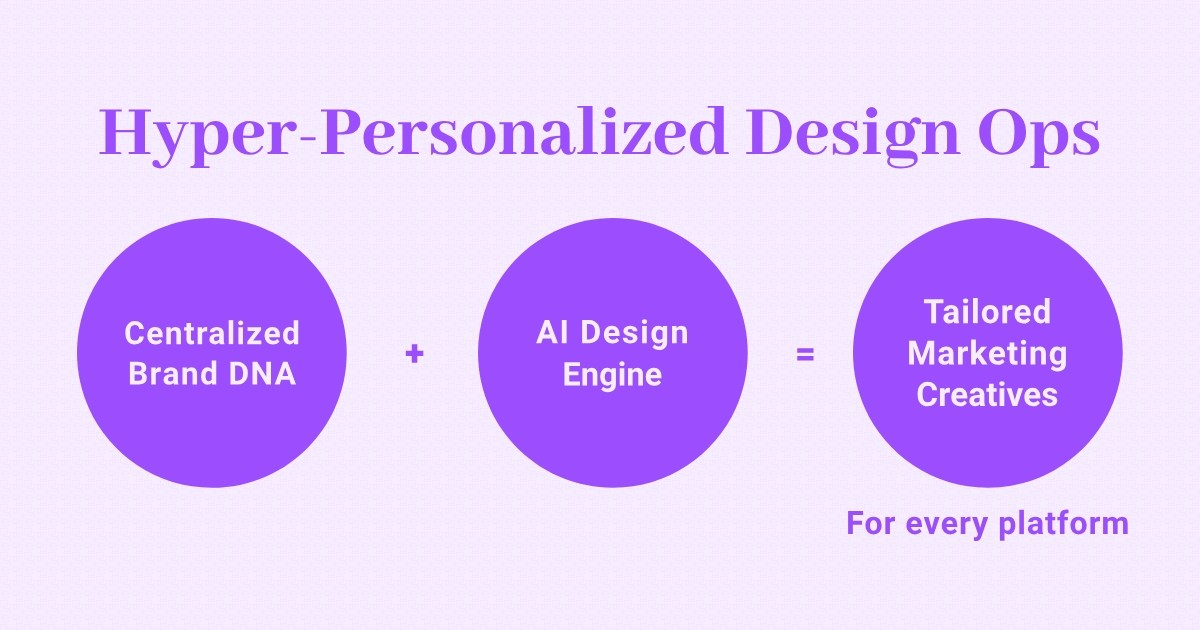
Instead of manually referring to 50-page brand PDF guides, you can setup your brand kit and components in Sivi. By defining your color science, typography rules, and composition preferences once, you ensure that every AI-generated asset is compliant by default. The LDM doesn't just see your brand; it understands its DNA.
2. Move from prompting to data-informed generation
You need not just ask an AI to make an ad. You can feed it your actual marketing data. Sivi's ability to extract content from URLs or structured content means you can point the LDM at a product page and let it reason through the hierarchy. It knows which headline is most important and which product shot deserves the focus.
3. Implement the agentic flow
The true differentiator in 2026 is the Agentic Design workflow. Sivi Gen-3 follows a three-stage loop: it forms and refines the input based on your intent, generates the design aligning with your brand DNA using the LDM, and then fine-tunes the result to ensure precision.
The 10x ROI of Generative Design
When you move to an LDM-based workflow, the metrics shift immediately:
- Production Speed: Bulk campaigns that took days now take minutes.
- Creative Focus: Designers spend 80% of their time on strategy and 20% on production, rather than the reverse.
- Hyper-Personalization: You can now afford to generate unique assets for every micro-segment of your audience without increasing your design budget.
Conclusion: The New Standard
Design Ops is no longer about managing a queue of requests, it is about managing a generative system. As we move into 2026, the competitive advantage will go to teams that stop pushing pixels and start directing intent.
The blueprint is ready. It's time to build.
Explore the Sivi LDM for Design Ops Teams
—
Frequently Asked Questions (FAQ)
What is Design Ops in marketing?
Design Operations (Design Ops) in marketing refers to the orchestration and optimization of people, processes, and craft to amplify design’s value and impact. In 2026, Scaling Design Ops involves using Large Design Models (LDM) to automate repetitive production tasks like resizing, localization, and high-volume asset generation.
How does an Agentic Flow improve Design Operations?
The Agentic Flow consisting of Input Refinement, Design Generation, and Fine-tuning improves Design Operations by introducing reasoning into the production pipeline. Instead of just guessing pixels, an Agentic LDM understands design hierarchy and brand intent, which reduces manual revisions and ensuring consistency across bulk campaigns.
What is the difference between an LDM and an image generator for Design Ops?
Standard image generators produce flat, uneditable raster images. A Large Design Model (LDM) creates atomic, multi-layered designs where text, shapes, and images remain fully editable. For Design Ops teams, this means a single generation can be adjusted or repurposed without starting from scratch, significantly accelerating production speed.
Can Design Ops teams ensure brand consistency with AI?
Yes. By centralizing brand DNA into digital brand kits and components within Sivi, Design Ops teams can ensure every AI-generated asset is compliant by default. The LDM follows these codified rules to maintain typography, color harmony, and composition across thousands of assets.

Author: Sona J Odayappan
Sona is the Co-Founder & Chief Design Officer of Sivi, a generative AI that turns text into business visuals. With a distinguished academic background, Sona started her career as an engineer before transitioning to a designer. Over the last 15+ years, Sona has worked with multiple startups and MNCs in diverse sectors and designed over 35 products. She has evangelized design thinking and formed successful design teams from scratch. Sona is a gold medalist, TiE Women Bangalore Entrepreneurs finalist, MeitY Women Entrepreneurs Award finalist, and an author of a popular design portal.